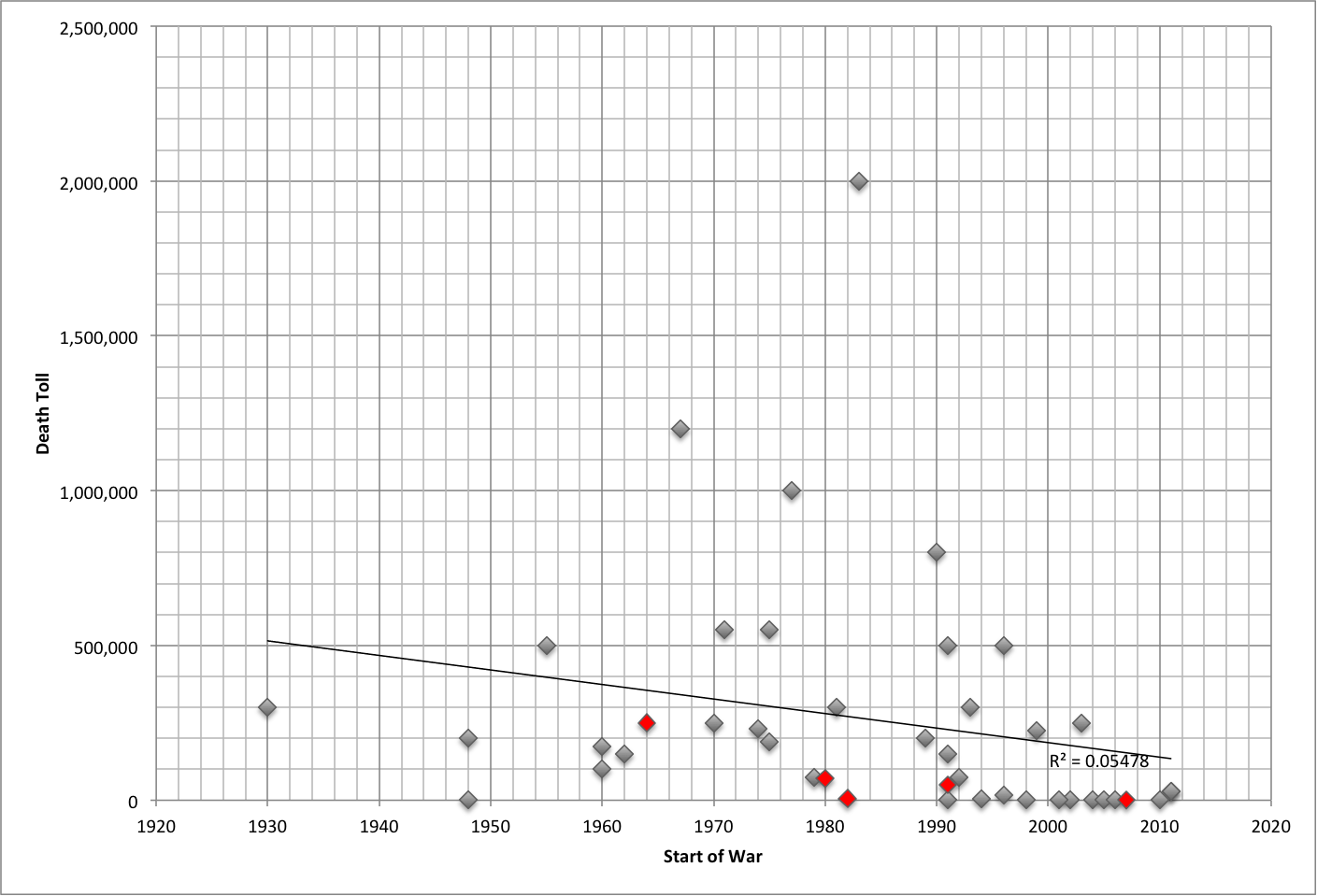
One year ago I made a post about the Syrian Civil War, comparing it to other civil wars in the
region over the past several decades. The war hasn’t come to an end, and now the
U.S. is heavily considering intervening.
If anything, the war has become an enormous global talking point within the
last few weeks and months. Because of that, I decided that it was time to take
a look back at the Civil War. How do my previous predictions look? And perhaps
more importantly, what would be the result of U.S. intervention in Syria?
Let’s start with
the easy question: Who is going to win? Last year, I said the rebels. Seems
legit. The rebels have more to fight for and if the U.S. were to intervene on
their behalf, things will really be looking up. (For both sides, really, if
bombs start getting dropped).
 |
| Something like this, with more panicking |
I also suggested
that about 200,000 people would be killed by the time the war was all over.
When I wrote the original post, only about 30,000 people had perished in a
little less than a year and a half of fighting. Within half a year, that number
jumped to 100,000.

The worst part about this number is
that about half of the deaths are from civilians, potentially more. This wasn’t
something that we saw back during the American Civil War or the American
Revolutionary War- most of those deaths were restricted to the battlefields.
But with most recent civil wars, the number of innocent bystanders that die
typically surpasses the number of
actual combatants.
Finally, let’s
look at the length we can expect the war to last. I projected the war to last
maybe eight years, so five or six more. Originally, I had thought this number
seemed a little bit high, because we had just seen the Libyan Civil War ended
and everyone was feeling pretty good about themselves for solving that problem
so quickly and efficiently (right?). Now, I’m a little bit more confident. I’m
not happy about it, but look at what
happened in Egypt. We thought that Egypt was going to be able to look after
itself and function normally after its part in the Arab Spring. Then July
happened. The fact is, those of us in the developed world often take stability
for granted. Even if the fighting technically stops within the next few months,
regardless of U.S. intervention, it’s still going to be a long road to
stability in Syria, and to be honest, I wouldn’t put my chips on them not
sliding back into a state of warfare. (That was… a lot of negatives.)
So at this point,
I’m comfortable saying that the Syrian rebels will eventually win the war, and
it’s going to take about five or six more years before it is run to its
completion. Clearly, unfortunately, I underestimated what the death toll would
look like. To note, though: I did suggest that about 2.71% of a country’s
population would typically lose their lives in the event of a civil war in that
region. For Syria, that amounts to just under 600,000 people- an estimate that
seems much more plausible now than last year.
But now let’s
talk about U.S. intervention in Syria. Typically, I prefer to stay away from
controversial topics, but since I’ve been involved in Syria since day 1 –er-
500 something, and since it doesn’t really seem to be all that controversial, why not?
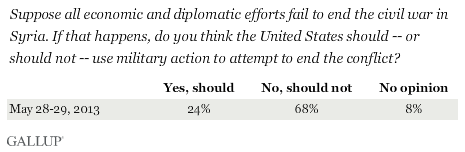
You already have
your own opinion of whether or not the U.S. should intervene in Syria, unless
you’re one of those carefree 8%. So I’m not even going to bother worrying about
whether we should or not intervene. I’m simply going to look at the results of
what would happen if we did intervene.
When the U.S.
gets attacked or involved in wars in which it has a serious investment in the
outcome (Revolutionary, 1812, Civil, Mexican, Native American, Spanish,
WWI&II), generally, we do pretty well. When we get involved in wars where-
and I’m choosing my words carefully- there is less directly at stake for the
American people… then our track record begins to waver. Slightly.
There is no real
trend for U.S. intervention in domestic disputes of other countries concerning
whether we have a positive or negative effect. Certainly, people remember
Vietnam and Korea as two interventions which may not have gone as planned.
Massive casualties mounted and the end results weren’t exactly what we wanted.
But it’s important to remember that there was intervention on both sides of
those wars from countries nearly as powerful as the U.S., such as China. That
would likely not be the case in Syria.
Perhaps it would
be better to consider some of the smaller, forgotten civil wars in which the
U.S. has been involved. In some cases, like the Dominican Republic in the
1960s, or Lebanon in 1958, the U.S. was involved right from the beginning, and
the wars only lasted a couple months. Victories were decisive with minimal
losses. When the U.S. isn’t involved from the beginning, there are checkered
results. In Laos, a civil war lasted for 22 years, 11 of which occurred despite
U.S. intervention. However, a relatively “low” amount of casualties were
experienced for a war of that length- if you can consider 20-70 thousand “low.”
Yet when the U.S. intervened in Cambodia, the bombings may have delayed the
inevitable conclusion of the war there by up to five years. A quarter million
people died in that eight-year dispute.
Clearly, each
scenario is different. The U.S. wants to get involved for different reasons;
different sides have different advantages or disadvantages, et cetera. The best
precedent we have for a situation like this is the one that occurred in Libya
in 2011. The U.S. and NATO intervened on the rebels’ behalf and six months
later, the war was over. It was a relatively short one, too.
I think that’s
the best scenario that the U.S. can hope for if it gets involved with Syria- a
quick ending to the war. But other factors suggest this won’t be quite as
“easy.” The government is much more stubborn- the alleged use of chemical
weapons certainly gives you some idea- and the war is already a full-blown war.
Historically, the U.S. hasn’t done quite as well when it has gotten involved in
wars this late- look at Cambodia, Laos, and Somalia- where the UN & U.S.
tried to get involved 20 years ago. That war is still ongoing. (They pulled out three years later, in 1995).
The civilian
casualties must also be taken into account. If the U.S. does indeed intervene
by bombing key al-Assad strongholds (with missiles that don’t exactly have
pinpoint accuracy), there will be a substantial amount of civilian deaths.
Those deaths have become a necessity for civil wars in recent years, unfortunately.
But I think everyone can agree that the U.S. should take the steps to minimize
those casualties as much as they can. The worst case scenario for U.S.
intervention? It’s Cambodia all over again; the bombings delay the end of the
war substantially, causing a significant civilian death toll on the side.
As the war
develops in the coming months- especially if the U.S. intervenes- remember
those predictions at the beginning of this post. 8 years. 600,000 deaths. And
the rebels are victorious. You can judge any foreign involvement as positive or
negative based on how the final numbers actually end up. Let us fervently hope
that those first two numbers are substantially lower.
And on that note,
here’s a picture of a cat: